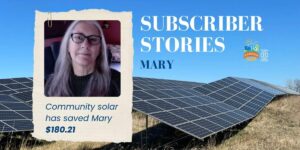
The Community Behind Community Solar: Meet Deirdre
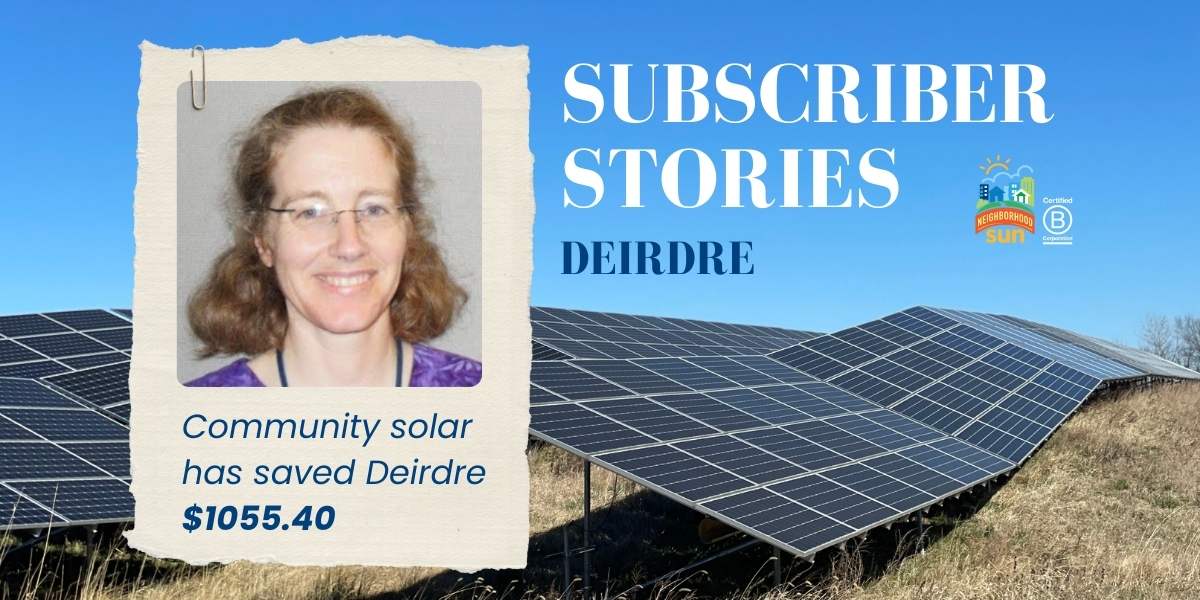
Deirdre earned her doctorate and works as a scientist for the National Oceanic and Atmospheric Administration (NOAA) studying factors that contribute to the rapid intensification of hurricanes. She subscribed her single-family home to community solar in 2019, while still abroad, right before moving back to Maryland from another country.
“I was living overseas, although I owned this property [in Maryland] at the time. As I was moving back, I was being told by my NOAA friends about this amazing outfit called Neighborhood Sun [doing] community solar. And I was like ‘Oh, I want that!’ So I think I signed up pretty much immediately.”
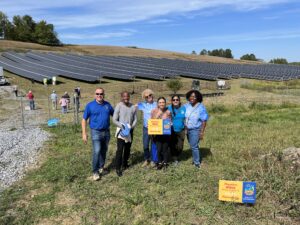
Deirdre was an early adopter when she subscribed in 2022 to the very first community solar farm managed by Neighborhood Sun, Panorama (see photo above). That was the same year Maryland’s initial pilot program for community solar was extended, only to later be made permanent in 2023 with the passing of HB 908. Since Deirdre’s home is surrounded by trees, rooftop panels were not an ideal match for her. In addition to protecting her neighboring trees, she noted other reasons to opt for community solar over installing her own rooftop panels.
“I didn’t really look at doing individual solar. Every time I talk to those people, they want me to cut down a tree. I would never cut down a tree. I mean, shade is more efficient than having your house heated up by the sun and then trying to cool it with solar panels. More trees are good. Let’s put the solar panels somewhere else. I have looked into it, and community solar is much more efficient [than individual rooftop solar] because you are building at scale, and you are using the existing grid.”
Although she’s happy to have approximately 90% of her household’s electricity needs covered by her community solar credits, she wishes it could be 100%. At Neighborhood Sun, we aim for ~90% coverage of a subscriber’s household usage to avoid potentially allocating more credits than their household would need. When subscribers have electric vehicles like Deirdre, we know to account for the extra electricity they’ll need to power their car as a part of their community solar share.
The financial savings is a bonus for me, but environmental impact is the primary motivator. I work in the lab that measures sea level rise for our nation, so I am acutely aware of our footprint and what it [climate change] is doing.
When asked why she chose Neighborhood Sun as her community solar provider, she mentioned that the company’s status as a Certified B Corp as a differentiating factor that earned her trust.
“They’re a B Corporation, and they seem to be very above board. My experience with Neighborhood Sun has been 100% positive.”