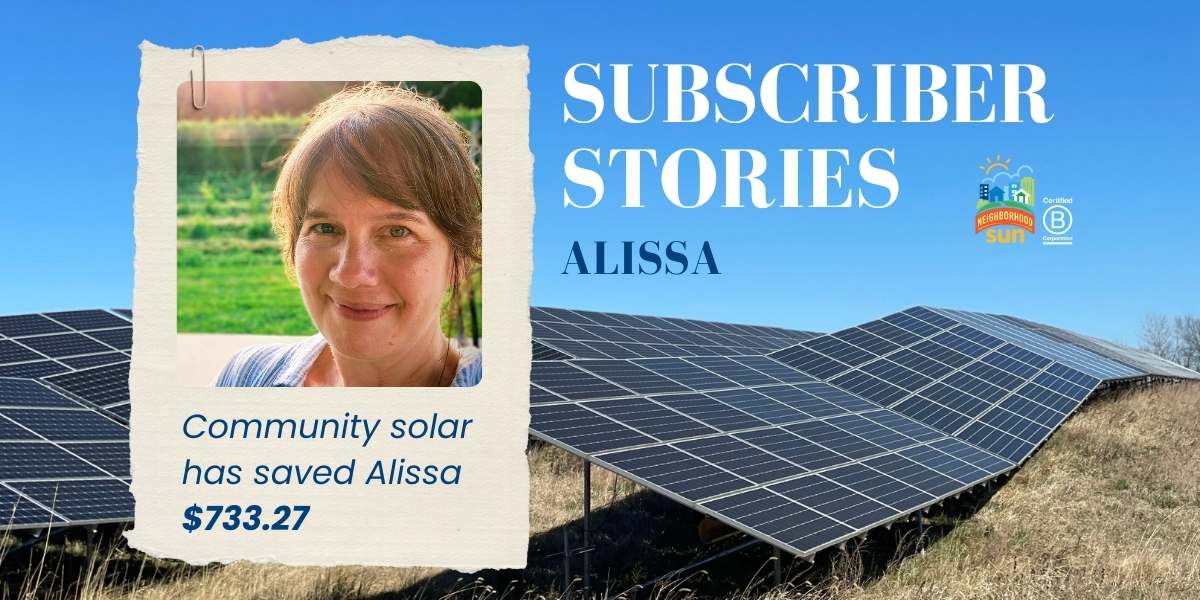
In the summer of 2022, Alissa, a Maryland schoolteacher, was looking for a way to switch her townhome’s electricity source away from fossil fuels to renewable energy.
“Me and my husband– well, me particularly, but my husband was happy to be along for the ride– had been looking for a renewable energy option, but the finances played into it– like, can we afford to do this? Is it going to require money up-front? So, community solar was an option that allowed us to have renewable energy and still fit our finances.”
Although their townhome would have been a great candidate for rooftop solar because they get lots of sun all day long on the roof, a few concerns were holding them back from installing their own panels. After hearing about complicated financing and payments when researching various rooftop solar companies, they were worried about the financial risk. They had also experienced structural issues, so they weren’t confident about putting anything on their roof. Like many people, when Alissa first discovered community solar, she first thought it was too good to be true.
“No, I mean honestly- other than the mild ‘this sounds so amazing- can it possibly be true?’- the whole process was very easy. I didn’t know anyone else who had done it, so I just did some internet research. It wasn’t a hard decision. Everything about it seemed wonderful.”
Alissa’s primary motivation in subscribing to community solar was her desire to shift away from fossil fuels, although her decision to support local solar still saved her $770 in just a few years. Alissa said she used to log in to Neighborhood Sun’s MySolar platform to check how much her monthly bill was going to be so she could match up her solar credits with her BGE bill. After learning where to find her credits on her BGE bill, she doesn’t feel the need to anticipate the credits by checking online anymore.
“If we were breaking even, that would be fine. Even if we were paying a little bit more, that would be fine. But we’re saving money every month. The fact that it’s so easy to do something sustainable– I mean it just makes it so easy to do something that helps our planet a teeny tiny bit. I love the fact that it’s in a community that’s not far from us.”
Sometimes, people think that since you’re paying for solar credits as a subscriber, there must be an additional cost to community solar or that the goal is to break even. Fortunately, the reality of is that there are no additional costs to community solar. Anything you’re paying for solar credits is money you would have paid to your utility for the electricity you consumed, even if you were not a community solar subscriber. Except as a subscriber, you get a discount on those solar credits that the utility would not have offered.