On a late-summer morning in 2024, two Neighborhood Sun team members set up a table at the Overlook, an affordable housing community in Washington, DC. They brought coffee, a box of donuts, and a simple offer for anyone who stopped by: bring your electric bill, and we’ll go over it with you. They weren’t there to make a hard sell.
They were there to answer a harder question, one that every resident had a right to ask: Why should I trust you?
Our multiyear commitment to inclusive outreach for this specific portfolio of community solar farms earned Neighborhood Sun a Climate and Energy Leadership Award from the Metropolitan Washington Council of Governments (COG). But the award is the last chapter. The story begins years earlier in 2022 when Enterprise Community Development (ECD), a nonprofit that builds and manages affordable housing across the Mid-Atlantic, subscribed one of its residences to community solar. Since then, they have saved over $63,000. After being a subscriber themselves, the nonprofit decided to build their own community solar farms on top of the building’s rooftops and a brand-new carport with electric charging powered by the solar panels above. They had hundreds of low-income residents in need of savings, but getting residents to sign up was the real challenge. That’s where Neighborhood Sun came in.
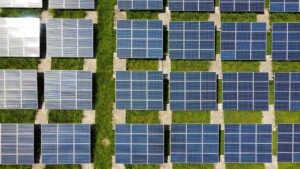
On paper, this opportunity was almost too good to be true. ECD built community solar farms on four of its DC properties: Arbor View, Edgewood Commons, the Overlook, and Randle Hill. Together they add up to about 2.2 megawatts of solar.
As a nonprofit, ECD made the generous choice. These projects normally give low-income subscribers a 20% discount, while the project owner would keep a 30% tax credit. ECD passed that 30% along to residents instead. That meant income-qualified subscribers would get a 50% discount on their solar credits for the farms’ entire 25-year life.
But “too good to be true” is exactly the problem. Low- and moderate-income (LMI) households are often the most cautious about energy offers, as they should be, unfortunately. Many have dealt with third-party energy suppliers whose promised savings turned into higher bills. When people have been burned by a promising offer, the issue is no longer the value you’re offering. It’s about the trust you’re building.
There were practical barriers too. Some residents speak Spanish as their first language. Many don’t have time for a meeting across town. And signing up for something new often means adding another payment method, which can be a real hurdle when money is tight. We knew a piece of paper on a bulletin board wouldn’t be enough. We had to actually show up and connect with people in a way that’s increasingly rare these days. Fortunately, that’s where our team excels.
Our partnership with ECD began in December 2023, when they hired us to enroll and manage the subscribers needed to fill the community solar farms they were building. ECD already hosted events that residents relied on, like food pantries and job fairs. We joined eight of them. We weren’t the main attraction, and that was the point. We were the friendly faces at the next table over, showing up event after event, happy to chat about electricity bills.
It helped that ECD wasn’t new to community solar or to us. Its properties had subscribed through Neighborhood Sun for years before ECD decided to develop community solar farms of their own. But that didn’t mean the residents were familiar with or trusting of the concept.
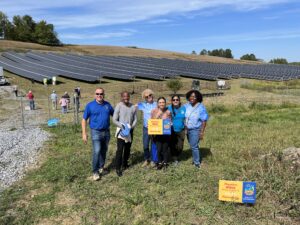
In 2024, our team, led on the ground by Sam and Natalia, held 13 outreach and training events. Each one was designed around residents’ daily routines, not our schedule. Winter started with solar info sessions at Arbor View and Randle Hill, plus an Arbor View community meeting. At Randle Hill, we hosted two lunch-and-learns, including a free pizza. In July, we joined Edgewood Commons’ community day in the courtyard. In late summer, we brought coffee and donuts to two morning hours at the Overlook, and held sign-up sessions at Edgewood Commons. We closed out the year with a December tabling event at Edgewood.
At almost every event, the conversation started with the same simple step: looking at the resident’s bill together. We’d help them check whether they were overpaying, sometimes due to the predatory practices of third-party energy suppliers. We weren’t selling anything in that moment. We were just being useful. That’s what made the difference. Once residents saw that we were looking out for them, they were far more open to hearing about community solar.
Trust got residents to the table. But we also had to do everything we could to make sure the economically and environmentally sustainable choice also happened to be an easy choice to make.
We made it make sense. We rewrote our welcome packet in plainer, more direct language. Nobody should need an energy degree to understand their own savings.
We spoke residents’ language, literally. We printed flyers in Spanish and brought a Spanish-speaking team member, Natalia Franco, to our events. For Spanish-speaking families, that meant getting answers in their own language, from a real person.
We brought in the people residents already trust. In September 2024, we trained more than 10 ECD property managers on how community solar works and how to explain it accurately. Property managers see residents every day, so they’re often the first person someone asks when they have questions.
Not everything went to plan. Delays on the utility side meant the farms were built and connected to the grid later than first expected. For residents who had just decided to trust us, that wait could have undone a lot of hard work.
“This program will help me save money, especially with the economy rates right now. I’m anticipating my bill being lower because of the solar panels. I’m hoping they start generating energy soon.” — Kem Robinson, ECD resident
So we kept talking. We shared updates with subscribers whenever timelines changed, so nobody was left wondering. We also built the first-ever community solar app, which lets subscribers check their farm’s details and timeline whenever they want. Being honest about the wait turned out to be another way of building trust.
Edgewood Commons, the last to be built, was wrapping up construction earlier this year, and most of its spots were already filled.
For a group that’s often called “hard to reach,” that’s a remarkable response. It tells us these families were never uninterested. They were waiting for someone to earn their trust.
“I subscribed to the program in October of 2024. I’m very happy to be able to get a discount on my electricity bill and to support clean energy in the city through Enterprise.” — Lidia Beltrán, ECD resident (translated from Spanish)
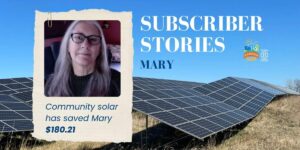
The savings are already real. The three running farms have generated more than $60,000 in solar credits for subscribers since they came online in late 2025 and early 2026. Over the farms’ 25-year life, ECD projects:
These figures are ECD’s estimates, based on system design and 2022 utility rates, so actual results will shift with electricity prices. Household counts are estimates too, since some subscribers are commercial accounts that serve many residents.
The benefits reach beyond the bill. ECD is working to use these solar arrays to power four EV charging stations, a discounted EV car-sharing program, and battery storage. ECD also runs a solar workforce training program for residents, and eight of its nine graduates were offered full-time jobs.
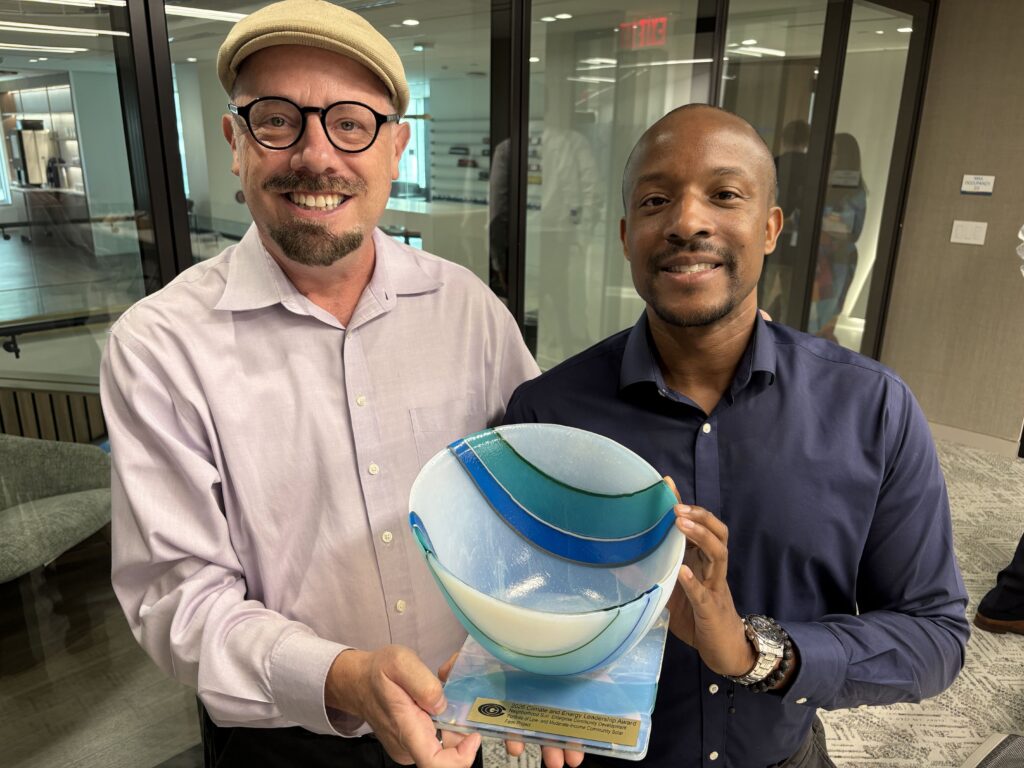
On October 14, 2026, COG named Neighborhood Sun the business sector recipient of its 2026 Climate and Energy Leadership Awards. The awards honor work that moves the Washington region toward its goal of cutting greenhouse gas emissions 50% below 2005 levels by 2030, while advancing equity in historically disadvantaged communities. We’re proud to share this year’s honors with the City of College Park, Arlington County, CEEJH INC, and Prince William County Public Schools.
If there’s one lesson we’d pass on, it’s this: when a community is called “hard to reach,” it usually means nobody has taken the time to reach them well. Trust takes showing up again and again, starting with how you can help, and removing every barrier you can find.
We’d also do one thing differently next time. Property managers are some of residents’ most trusted voices, but they had no added reason to champion community solar. A small incentive for property managers could help even more families sign up.
We believe this model can work wherever there’s a state community solar program, available solar capacity, and a housing partner willing to pass the savings on to residents. ECD has shown just how far that generosity can go.
To everyone at Enterprise Community Development, the property managers who joined us, and every resident who pulled up a chair at our table: thank you.

If you are getting solar from: